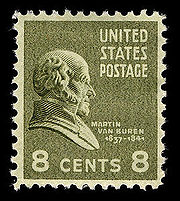
Martin Van Buren (
December 5,
1782 –
July 24,
1862), nicknamed
Old Kinderhook, was the eighth
President of the United States from 1837 to 1841. Before his presidency he served as the eighth
Vice President (1833-1837) and the 10th
Secretary of State under
Andrew Jackson. He was a key organizer of the
Democratic Party, a dominant figure in the
Second Party System, and the first president who was not of English, Irish, Welsh, or Scottish descent. Van Buren was the first President who did not experience the
American Revolution firsthand. He is also the only president not to have spoken English as a first language, having grown up speaking
Dutch.
Van Buren was the first of a series of eight presidents between
Andrew Jackson and
Abraham Lincoln who served one term or less. He also was one of the central figures in developing modern political organizations. As
Andrew Jackson's Secretary of State and then Vice President, he was a key figure in building the organizational structure for
Jacksonian democracy, particularly in New York State. However, as a President, his administration was largely characterized by the economic hardship of his time, the
Panic of 1837. Between the bloodless
Aroostook War and the
Caroline Affair, relations with Britain and its colonies in Canada also proved to be strained. Whether or not these are directly his fault, Van Buren was voted out of office after four years, with a close popular vote but a rout in the electoral vote. In 1848 he ran for president on a third party ticket, the
Free Soil Party.
Biography Early political career As a member of the state Senate, he supported the
War of 1812 and drew up a classification act for the enrollment of volunteers. He broke with
DeWitt Clinton in 1813 and tried to find a way to oppose Clinton's plan for the
Erie Canal in 1817. Van Buren supported a bill that raised money for the canal through state bonds, and the bill quickly passed through the legislature with the help of his Tammany Hall compatriots. When the 96-mile stretch of the Erie Canal from
Utica to
Syracuse, New York opened in 1819, Van Buren tried to take credit away from Clinton and keep it for himself. His supporters guaranteed money for the canal in 1821, and they drove Clinton from the governor's office.
Van Buren's attitude towards
slavery at the moment was shown by his vote, in January 1820, for a resolution opposing the admission of
Missouri as a slave state (though he himself was a slave owner). In the same year, he was chosen a presidential
elector. It is at this point that Van Buren's connection began with so-called "machine politics". He was the leading figure in the "
Albany Regency," a group of politicians who for more than a generation dominated much of the politics of New York and powerfully influenced those of the nation. The group, together with the political clubs such as
Tammany Hall that were developing at the same time, played a major role in the development of the "
spoils system" a recognized procedure in national, state and local affairs. The Bucktails became a loyal faction with a large amount of party loyalty, and through their actions they were able to capture and control many patronage posts throughout New York. Van Buren did not originate the system but gained the nickname of "Little Magician" for the skill with which he exploited it. He served also as a member of the state
constitutional convention, where he opposed the grant of universal suffrage and tried to keep property requirements.
New York State Politics In February 1821, Van Buren was elected to the
United States Senate. Van Buren at first favored internal improvements and in 1824 proposed a constitutional amendment to authorize such undertakings. The next year, however, he took ground against them. He voted for the
tariff of 1824 then gradually abandoned the protectionist position, coming out for "tariffs for revenue only."
In the
presidential election of 1824, Van Buren supported
William H. Crawford and received the electoral vote of
Georgia for
vice-president, but he shrewdly kept out of the acrimonious controversy which followed the choice of
John Quincy Adams as President. Van Buren had originally hoped to block Adams' victory by denying him the state of New York (the state was divided between Van Buren supporters who would vote for
William H. Crawford and Adams' men). However, Representative
Stephen Van Rensselaer swung New York to Adams and thereby the 1824 Presidency. He recognized early the potential of
Andrew Jackson as a presidential candidate.
After the election, Van Buren sought to bring the Crawford and Jackson followers together and strengthened his control as a leader in the Senate. Always notably courteous in his treatment of opponents, he showed no bitterness toward either
John Quincy Adams or
Henry Clay, and he voted for Clay's confirmation as
Secretary of State, notwithstanding Jackson's "
corrupt bargain" charge. At the same time, he opposed the Adams-Clay plans for internal improvements and declined to support the proposal for a Panama Congress. As chairman of the Judiciary Committee, he brought forward a number of measures for the improvement of judicial procedure and, in May 1826, joined with Senator
Thomas Hart Benton in presenting a report on executive patronage. In the debate on the "
tariff of abominations" in 1828, he took no part but voted for the measure in obedience to instructions from the New York legislature—an action which was cited against him as late as the
presidential campaign of 1844.
Van Buren was not an orator, but his more important speeches show careful preparation and his opinions carried weight; the oft-repeated charge that he refrained from declaring himself on crucial questions is hardly borne out by an examination of his senatorial career. In February 1827, he was re-elected to the Senate by a large majority. He became one of the recognized managers of the Jackson campaign, and his tour of
Virginia, the
Carolinas, and
Georgia in the spring of 1827 won support for Jackson from Crawford. Van Buren sought to reorganize and unify "the old Republican party" behind Jackson. Van Buren helped create a grassroots style of politicking that is often seen today. At the state level, Jackson's committee chairmen would split up the responsibilities around the state and organize volunteers at the local level. "Hurra Boys" would plant hickory trees (in honor of Jackson's nickname, "Old Hickory") or hand out hickory sticks at rallies. Van Buren even had a New York journalist write a campaign piece portraying Jackson as a humble, pious man. "Organization is the secret of victory," an editor in the Adams camp wrote. "By the want of it we have been overthrown." In 1828, Van Buren was elected
governor of New York for the term beginning on January 1, 1829, and resigned his seat in the Senate.
Van Buren's tenure as NY governor is the second shortest on record, and nothing of note took place.
U.S. Senate and National Politics On March 5, he was appointed by President Jackson as
Secretary of State, an office which probably had been assured to him before the election, and he resigned the governorship. He was succeeded in the governorship by his Lieutenant Governor,
Enos T. Throop, a member of the regency. As secretary of state, Van Buren took care to keep on good terms with the "kitchen cabinet," the group of politicians who acted as Jackson's advisers. He won the lasting regard of Jackson by his courtesies to Mrs. John H. Eaton (
Peggy Eaton), wife of the
Secretary of War, with whom the wives of the cabinet officers had refused to associate. He did not oppose Jackson in the matter of removals from office but was not himself an active "spoilsman". He skillfully avoided entanglement in the Jackson-
Calhoun imbroglio.
No diplomatic questions of the first magnitude arose during Van Buren's service as secretary, but the settlement of long-standing claims against France was prepared and trade with the
British West Indies colonies was opened. In the controversy with the
Bank of the United States, he sided with Jackson. After the breach between Jackson and Calhoun, Van Buren was clearly the most prominent candidate for the vice-presidency.
The Jackson Cabinet In December 1829, Jackson had already made known his own wish that Van Buren should receive the nomination. In April 1831, Van Buren resigned from his secretary of state position, as a result of the
Petticoat Affair- though he did not leave office until June. However, Van Buren still played a part in the Kitchen Cabinet. In August, he was appointed minister to the Court of St. James (
United Kingdom), and he arrived in London in September. He was cordially received, but in February, he learned that his nomination had been rejected by the Senate on January 25. The rejection, ostensibly attributed in large part to Van Buren's instructions to
Louis McLane, the American minister to England, regarding the opening of the West Indies trade, in which reference had been made to the results of the election of 1828, was in fact the work of
Calhoun, the vice-president. And when the vote was taken, enough of the majority refrained from voting to produce a tie and give Calhoun his longed-for "vengeance." No greater impetus than this could have been given to Van Buren's candidacy for the vice-presidency.
After a brief tour on through Europe, Van Buren reached New York on
July 5,
1832. The
1832 Democratic National Convention (the party's first), held in May of that year, had nominated him for vice-president on the Jackson ticket, despite the strong opposition to him which existed in many states. No platform was adopted because the widespread popularity of Jackson was being relied upon to succeed at the polls. His declarations during the campaign were vague regarding the tariff and unfavorable to the United States Bank and to
nullification, but he had already somewhat placated the South by denying the right of Congress to abolish slavery in the
District of Columbia without the consent of the slave states.
Vice-Presidency Main article: United States presidential election, 1836 Election of 1836 Presidency 1837-1841 Martin Van Buren announced his intention "to follow in the footsteps of his illustrious predecessor," and retained all but one of Jackson's cabinet. Van Buren had few economic tools to deal with the
economic crisis of 1837. Van Buren advocated lower tariffs and free trade, and by doing so maintained support of the south for the Democratic party. He succeeded in setting up a system of bonds for the national debt. His party was so split that his 1837 proposal for an "Independent Treasury" system did not pass until 1840. It gave the Treasury control of all federal funds and had a legal tender clause that required (by 1843) all payments to be made in legal tender rather than in state bank notes. But the act was repealed in 1841 and never had much impact. Foreign affairs were complicated when several states defaulted on their state bonds, London complained, and Washington explained it had no responsibility for those bonds. British authors such as
Charles Dickens then denounced the American failure to pay royalties, leading to a negative press in Britain regarding the financial honesty of America. The
Caroline Affair involved Canadian rebels using New York bases to attack the government in Canada. On
December 29,
1837, Canadian government forces crossed the frontier into the US and burned the
Caroline, which the rebels had been using. One American was killed, and an outburst of anti-British sentiment swept through the U.S. Van Buren sent the army to the frontier and closed the rebel bases. Van Buren tried to vigorously enforce the neutrality laws, but American public opinion favored the rebels. Boundary disputes in May brought Canadian and American lumberjacks into conflict. There was no bloodshed in this
Aroostook War, but it further inflamed public opinion on both sides.
In a bold step, Van Buren reversed Andrew Jackson's policies and sought for peace at home, as well as abroad. Instead of settling a financial dispute between American citizens and the Mexican government by force, Van Buren wanted to seek a diplomatic solution. Also, in August of 1837, Van Buren denied Texas's formal request to join the United States. "Van Buren gave a higher priority to sectional harmony than to territorial expansion" ("Martin Van Buren" 103-114). In the
Amistad Case Van Buren sided with the Spanish Government to return the kidnapped slaves. Also, he oversaw the "
Trail of Tears", which involved the expulsion of the
Cherokee tribe in 1838 from Georgia, Tennessee, Alabama, and North Carolina to the Oklahoma territory. Van Buren was determined to avoid war.
Van Buren took the blame for hard times, as Whigs ridiculed him as
Martin Van Ruin. Van Buren's rather elegant personal style was also an easy target for Whig attacks, such as the
Gold Spoon Oration. State elections of 1837 and 1838 were disastrous for the Democrats, and the partial economic recovery in 1839 was offset by a second commercial crisis in that year. Nevertheless, Van Buren controlled his party and was unanimously renominated by the Democrats in 1840. The revolt against Democratic rule led to the
election of
William Henry Harrison, the
Whig candidate.
In 1839,
Joseph Smith, Jr., the founder of the
Latter Day Saint movement visited Van Buren to plead for the U.S. to help roughly 40,000 Mormon settlers of Independence, Missouri, who had been attacked, killed, raped, and run out of the state from their lands (eventually settling in Utah). The Governor of Missouri,
Lilburn Boggs, had issued an executive order on
27 October 1838, known as the "
Extermination Order". It authorized Missourians to "exterminate" Mormons and encouraged them to do so. "Van Buren entered the presidency not only as the heir to Jackson's policies, Jefferson's ideology of limited government, and Smith's principles of political economy, but also an accomplished politician with a statesmanlike vision of the dangers facing the nation. This complex heritage would shape the new president's response to the multiple challenges of 1837."("Martin Van Buren" 103-114)
Policies  Supreme Court appointments
 On the expiration of his term, Van Buren retired to his estate,
Lindenwald in Kinderhook, where he planned out his return to the White House. He seemed to have the advantage for the nomination in 1844; his famous letter of
April 27,
1844, in which he frankly opposed the immediate annexation of
Texas, though doubtless contributing greatly to his defeat, was not made public until he felt practically sure of the nomination. In the Democratic convention, though he had a majority of the votes, he did not have the two-thirds which the convention required, and after eight ballots his name was withdrawn.
James K. Polk received the nomination instead.
In 1848, he was nominated by two minor parties, first by the "
Barnburner" faction of the Democrats, then by the
Free Soilers, with whom the "Barnburners" coalesced. He won no electoral votes, but took enough votes in New York to give the state — and perhaps the election — to
Zachary Taylor. In the election of 1860, he voted for the
fusion ticket in New York which was opposed to
Abraham Lincoln, but he could not approve of
President Buchanan's course in dealing with secession and eventually supported Lincoln.
After being bedridden with a case of pneumonia during the fall of 1861, Martin Van Buren died of bronchial
asthma and
heart failure at his Lindenwald estate in Kinderhook at 2:00 a.m. on
July 24,
1862. He is buried in the
Kinderhook Cemetery.
Later life Van Buren was the first President born after the signing of the
Declaration of Independence (1782). The first seven Presidents were born as British subjects.
William H. Harrison was also born during British rule.
 Trivia Second Party System American election campaigns in the 19th century U.S. presidential election, 1832 U.S. presidential election, 1836 U.S. presidential election, 1840 U.S. presidential election, 1848 See also Primary sources
Life in the
Netherlands The Dutch have a
code of etiquette, the code that governs the expectations of social behaviour, and it is considered very important. Because of the international position of
the Netherlands many books have been written on the subject.
Some customs listed here may not be true in all regions of the Netherlands, and they are never absolute. Nevertheless these are generally accepted modern customs in the Netherlands. Some customs have changed over the course of
history.
In addition to those specific to the Dutch, many general points of
European ettiquette apply to the Dutch as well.
Abortion Drug policy Euthanasia Prostitution Same-sex marriage Pillarisation  The people
 When entering a
room it is customary to shake hands with everyone present whether it be men, women, or children. Shake hands again when you leave. Usually if accompanied by an acquaintance he or she will introduce you to others; if no one is present to introduce you, do it yourself. The Dutch consider it rude not to identify yourself.
- When stopping in the street to have a small chat with an acquaintance, a younger Dutch person especially will not take the trouble of introducing an accompanying friend to this acquaintance.
Phrases used for saying hello or goodbye differ quite a bit between regions, but are generally understood everywhere. However, the use of dialectal forms, for example the Brabantic "houdoe", will really identify you as a person from that particular region, which might be met with surprise if you are a non-native.
When introducing themselves the Dutch will shake hands and will generally say either their first or their surname.
When answering the phone Dutch people say their first and/or last name, usually preceded by "met", which means (you're speaking) with, and not with just "Hello" or "Hi". This is usually on the case when the answerer has no caller id. When picking up a friend, the greeting is usually more loose.
- Children tend to answer the phone by saying their full name (first + surname) to avoid being mistaken for their parents as the Dutch often get straight to business and tend to chat afterwards.
When one spots or makes eye contact with someone you know with a relative distance in between, for example when on opposite sides of a street, it would be wise not to yell for this person. It is considered impolite to shout a greeting, and will probably cause some annoyed looks. Instead, wave if greeting someone from a distance, or quicken your pace to catch up with them.
When arriving at someone else's house, do not step in the house without being explicitly asked to do so. The Dutch consider such an action a huge invasion of their privacy and authority.
Be careful what you do even when told to "make yourself at home"; the Dutch don't take kindly to people who go "searching" their house or even as much move one step forward too much.
It is a good idea to ask where you may be seated as taking a seat in the house owner's personal chair or spot on the sofa can make the house owner feel invaded.
When meeting with friends and relatives, the Dutch usually kiss each other on the cheeks three times. Normally, the first kiss is given on the left cheek, the second kiss on the right cheek and the third kiss again on the left cheek. Women will kiss women and men, whereas men will only kiss women and shake hands with other men. This ritual is also often used when saying goodbye.
- However, male acquaintances or friends, when not related, generally do not shake hands or have any other physical contact upon meeting and leaving and saying goodbye on a day-to-day basis. Greetings
Compared to most cultures, the Dutch are rather reserved in public and do not often touch each other or display anger or extreme exuberance.
The Dutch value privacy and seldom interact with strangers, no matter where they are from. However this should not discourage foreigners in their actions. Dutch people are very curious and when addressed will most often converse or try to converse with them or be of any assistance.
The Dutch expect eye contact while speaking with someone. Looking away or staring at the ground is considered impolite and may be perceived as if you are lying.
The same, but to a lesser extent, goes for hand gestures accompanying speech. The Dutch tend to be reserved in using hand gestures. However, having your hands in your pockets or your arms crossed might be interpreted as a sign of disinterest.
- Moderate hand gestures do, however, give the impression of self-confidence and they make the user look social and approachable. Using hand gestures to accompany your speech is usually seen as a characteristic of an 'open' personality.
The crazy sign is made by tapping the centre of your forehead with your index finger. This gesture is considered very rude.
- To make things even more complex, the sign indicating someone is smart or intelligent is made by tapping the area around temporal bone (just above the ear) with the index finger.
Another rude sign is to 'give someone the finger' by raising your hand and sticking up your middle finger. If this sign is accompanied by slapping the elbow of the raised arm with the palm of the other hand, it turns into one of the most insulting sexual gestures that exist in Dutch culture.
Nodding the head is a sign of agreement, but shaking the head from right to left is very rarely a sign of disagreement. Rather, the shaking of the head tends to imply disapproval or (if combined with looking away) sadness and compassion.
Winking at strangers (when not accompanying an insider's joke) will generally be perceived as a sexual advance and is unlikely to be appreciated. Dutch society values equality and women are considered equal to men. For this reason most women are unlikely to be charmed by sexual advances of the sort. Body language
To beckon a waiter or waitress, raise your hand and/or make eye contact. This usually works, if not just say "ober" (waiter) or "mevrouw" (which normally means "madam", but in the context of a waitress it is correct).
- Leaving a small tip is customary in restaurants.
In most cases the Dutch will make it clear when they intend to pay the bill, if not assume to "go Dutch" and pay your share. No one will be embarrassed at splitting the bill and the latter generally is the norm rather than the exception.
- However, on a romantic date, the man is expected to pay for the woman (although she may offer to pay her share, this is purely out of politeness) She may leave the tip for the waiter.
Dutch manners are frank and can be described as a no-nonsense attitude, informality combined with strict adherence to basic etiquette. This might be perceived as impersonal by some other cultures but is simply the norm in Dutch culture. As always, manners can differ between groups of people. Asking about basic rules will probably not be considered impolite.
Food does not play a major role in hospitality, like it does in many other cultures. It is not considered imperative for making someone feel welcome.
Do not expect to be served a meal unless the invitation specifically mentions a meal. Do not try to stay over until dinner is about to be served, it is considered rude as dinner is often considered a precious family moment, or at the very least a private moment. Usually only family or the closest of friends may join without asking.
- When inviting a Dutch person over for dinner do not expect to be invited back, as cooking skills and food are not considered very important.
When invited over for dinner by a student or a younger person, you may be asked to share in the costs of the ingredients.
If one does get invited for dinner then please note that in a formal setting the men are expected to wait until all women are seated before they themselves sit down.
- This, of course, is subject to the people you will be dining with and the formality of the dinner.
Try to start by taking a small to regular quantity of food. A second helping will be offered and it is polite to accept.
While eating remember to keep your hands on the table at all times during a meal. However make sure you keep your elbows off the table, as it is considered impolite. (Dinner) Parties may continue until very late in the evening, even early morning.
- Plan to stay for an hour or two after dinner. The Dutch dine early: often around 6 pm, unusually after 7 pm. But don't let good times be spoiled by your interpretation of these guidelines.
Do not ask for a tour of your host's home; it is considered impolite. If offered, however, accepting is considered to be the polite response. Dining and entertainment
The Dutch avoid the use of superlatives to illustrate points. Compliments are offered sparingly. When something is "not bad", "OK" or "nice", it is good, the remark is a praise, rather than a sign of disinterest.
A person who never criticizes others or who's afraid to speak on his or her own behalf is seen as either being simple-minded or failing to tell the truth. Foreigners do not need to worry much about saying something that might (in their own culture) hurt feelings or be perceived as an insult. The Dutch will argue, but seldom take offense.
The Dutch speak directly and use a lot of eye contact. To a foreigner this might seem to be very intimidating, especially in cultures where matters are discussed with extreme care and politeness, but it is just the way the Dutch prefer to communicate.
In most languages, including English, the term "Holland" or similar is used incorrectly as a synonym for the Netherlands, by people who are not aware of the distinction between the two, similar to the way that the term "England" is incorrectly used as a synonym for the United Kingdom of Great Britain and Northern Ireland in many languages. Calling the Netherlands "Holland" when speaking to Dutch people may cause a discussion about what Holland actually is, but will rarely cause them to be offended. Remember that Holland is a region in the Netherlands, consisting of 2 (out of 12) provinces (North Holland and South Holland)
- An exception is football, as the Dutch in that case will sometimes refer to their country as "Holland".
Do not discuss expensive items you have purchased recently (or anything similar), as the Dutch will most likely interpret this as boasting about it. Asking personal questions is equally dangerous, as the Dutch are quite private and will most likely feel uncomfortable answering questions that are (in their interpretation) too personal.
- This especially includes asking about income or other personal finances; asking how much someone makes will be seen as very rude, and volunteering your own income may be seen as pretentiousness.
Globally the Dutch are thought to be good at languages. This is true to some degree. The Netherlands have a very high standard of education and an education system which greatly focuses on the international position of their country.
- According to a census, about 85% of the Dutch people are able to speak a reasonable amount of English although the accent can be quite present. While this doesn't imply fluency, they usually know enough to show you the way or explain where one can have a decent meal.
In the Eastern regions, the Dutch generally also speak German reasonably well. French is the third foreign language, but far less commonly spoken than English or German.
- Especially younger people generally do not have a lot of sympathy for the fact that English as a second language is not as widespread in other countries as in the Netherlands.
Trying to address the Dutch in their own native language may often result in a reply in English, depending of course on your perceived skill in Dutch. This can be frustrating for those who wish to improve their Dutch while those who are competent in Dutch may find replies in English patronizing. But Dutch people will perceive a foreigner trying to speak Dutch as someone who's having great difficulties trying to express him or herself (due to the difficult pronunciation), or they may even welcome the opportunity of trying their English on you.
- If you prefer to speak Dutch though, this is usually no problem and the Dutch will often correct you or help you with the correct pronunciation of words. Most Dutch will find it charming that someone is trying, although some may be genuinely surprised that a foreigner is attempting to learn his language. Conversation and language
Dutch humor has changed a lot over the centuries. In the 16th century for example, the Dutch were renowned for their humor throughout Europe, and a large number of travel journals have notes on the happy and celebratory nature of the Dutch. Farces, joke books were in great demand and many Dutch painters deliberately chose to paint humorous paintings, Jan Steen being a good example.
The main subjects in Dutch jokes at the time were; deranged households, stupid Germans, drunk priests, and people with physical handicaps. However, at the end of the 17th the Dutch 'lost' their sense of humor. The Dutch Republic was in steady decline, the Dutch reformed church denounced laughter and advocated sober lifestyles and special etiquette manuals appeared which considered it uncivilized and rude to laugh out loud, or certain subjects. This state of humor more or less continued into the sixties of the 20th century. It is interesting to remark that during the Second World War Americans soldiers in the Netherlands were instructed not to tell jokes to the Dutch, as "they wouldn't appreciate it". Current Dutch humor is subtle and somewhat black, rather than slapstick. It uses sarcasm in order to get a point across, in more or less the same way as English humor does. When making fun of other nations, the Dutch often target Germans, due to their perceived arrogance, and Belgians when it concerns stupidity.
230 women and children
50 wounded 150 missing
39 wounded
For other uses, see Wounded Knee (disambiguation). The
Battle of Wounded Knee Creek was the last major armed conflict between the
Dakota Sioux and the
United States, subsequently described as a "
massacre" by
General Nelson A. Miles in a letter to the Commissioner of Indian Affairs. Around 150 Lakota are believed to have fled the chaos, many of whom may have died from
hypothermia.
Lakota prelude This article or section is in need of attention from an expert on the subject. WikiProject History or the
History Portal may be able to help recruit one. If a more appropriate
WikiProject or
portal exists, please adjust this template accordingly.
Main article: Ghost Dance Ghost Dance
 On
December 15, an event occurred prior to the Battle at Wounded Knee Creek. Chief
Sitting Bull was killed at his cabin on the Standing Rock Reservation by Indian police who were trying to arrest him on government orders. Sitting Bull was one of the Lakota's tribal leaders, and after his death, refugees from Sitting Bull's tribe fled in fear. They joined Sitting Bull's half brother,
Big Foot, at a reservation at
Cheyenne River. Unaware that Big Foot had renounced the Ghost Dance, General Nelson A. Miles ordered him to move his people to a nearby fort. On
December 28,
1890, Big Foot became seriously ill with
pneumonia. His tribe then set off to seek shelter with
Chief Red Cloud at
Pine Ridge reservation. Big Foot's band was intercepted by Major
Samuel Whitside and his battalion of the Seventh Cavalry Regiment and were escorted five miles westward to Wounded Knee Creek. There, Colonel
James W. Forsyth arrived to take command and ordered his guards to place four
Hotchkiss guns in position around the camp. The soldiers numbered around 500 — the Indians, 350; all but 120 were women and children. A rumor among the Lakota during the evening of
December 28,
1890, said that all Indians were to be deported to Indian Territory (
Oklahoma) which had the reputation for living conditions far worse than any prison. The Lakota became fearful that the rumor was true. The interpreter was not fluent in the peculiar dialect of Hohwoju used by Big Foot's people, and he mistranslated the Indians' speeches making them appear more belligerent than they actually were. Eyewitness accounts also claimed that the soldiers had been drinking and celebrating the capture of Big Foot.
Big Foot On
December 29, the Lakota were informed that it was necessary to turn in any weapons they possessed to prevent violence. A search was ordered, and some of the weapons were collected. A medicine man called Yellow Bird began to perform the Ghost Dance, reiterating his assertion the Lakota that the ghost shirts were bullet-proof. As tension mounted, Black Coyote (a defiant tribe member) refused to give up his rifle unless he was paid fair value for it -- he was deaf. Two soldiers seized him from behind and in the struggle, Black Coyote came down with his rifle -- it discharged, sending a shot into the air. At that same moment, Yellow Bird threw some dust into the air, and approximately five young Lakota men with concealed weapons threw aside their blankets, and pointed their rifles at Troop K of the 7th. The Lakota opened fire on the soldiers doing damage, however, a massive volley was returned back at the tribe. At first, the struggle was fought at close range, but as the Indians ran out of ammunition for their repeating rifles, the fight moved as the Indians sought to escape fire from the troops. By the end of fighting, which lasted less than an hour, over 150 Lakota had been killed and 50 wounded. In comparison, army casualties numbered 25 dead and 39 wounded.
The Battle The military hired civilians to bury the dead Lakota after an intervening snowstorm had abated. Arriving at the battleground, the burial party found the deceased frozen in contorted positions by the freezing weather. They were gathered up and placed in a common grave. It was reported that four infants were found still alive, wrapped in their deceased mothers' shawls. In all, 84 men, 44 women, and 18 children reportedly died on the field, while at least seven of Lakota were mortally wounded. There are unsubstantiated claims that these numbers are under reported by almost half.
Colonel Forsyth was immediately denounced by General Nelson Miles and relieved of command. An exhaustive
Army Court of Inquiry convened by Miles criticized Forsyth for his tactical dispositions but otherwise exonerated him of responsibility. The Court of Inquiry, however—while it did include several cases of personal testimony pointing toward misconduct—was flawed.
The American public's reaction to the battle was at the time generally favorable. Twenty
Medals of Honor were awarded for the action. A decade later when these were reviewed, Miles saw that they were retained. Currently, Native Americans are urgently seeking the recall of what they refer to as "Medals of Dis-Honor". Many non-Lakota living near the reservations interpreted the battle as a defeat of a murderous cult, though some confused Ghost Dancers with Native Americans in general. In an editorial in response to the event, a young newspaper editor,
L. Frank Baum (later known as the author of
The Wonderful Wizard of Oz), wrote in the
Aberdeen Saturday Pioneer on
January 3,
1891:
"
The Pioneer has before declared that our only safety depends upon the total extermination of the Indians. Having wronged them for centuries, we had better, in order to protect our civilization, follow it up by one more wrong and wipe these untamed and untamable creatures from the face of the earth. In this lies future safety for our settlers and the soldiers who are under incompetent commands. Otherwise, we may expect future years to be as full of trouble with the redskins as those have been in the past."
[1] 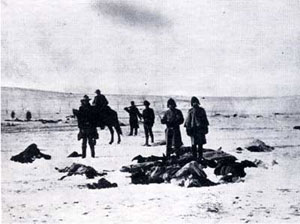 Skirmish at Drexel Mission
 In the late 20th century, critical reaction to the event became more widespread and vocal. Many consider the incident one of the most grievous
atrocities in United States history. In 1970, it was the subject of the best-selling book "
Bury My Heart at Wounded Knee" by historian
Dee Brown.
In 1972,
Johnny Cash wrote and released a song entitled "Big Foot" describing the tragedy at Wounded Knee. Like many of Cash's songs about Native Americans, it describes their poor treatment and victimization.
More than eighty years after the massacre, beginning on
February 27,
1973, Wounded Knee was also the site of a
71-day standoff between federal authorities and militants of the
American Indian Movement.
In 1973, the American rock band
Redbone, which was formed by two Native Americans, released the politically oriented song "We were all wounded at Wounded Knee", recalling the Battle of Wounded Knee Creek in 1890. The song ends with the subtly altered sentence "We were all wounded
by Wounded Knee". The song reached the number one chart position across Europe but did not chart in the U.S. where it was initially withheld from release and then banned by several radio stations.
'Wounded Knee' is a track from
Nik Kershaw's 1989 album "
The Works". The lyrics in the first 2 verses portray the persecution of fictitious native peoples of an "island in the sun" and a "village in the trees" after the arrival of the "white man". The theme in the chorus is that this is a repetition of what happened at Wounded Knee: "Oh no, not a Wounded Knee again". The final verse refers back to the plight of Native American Indians: "We were pow-wowing to our hearts content; We had the great spirit, we didn't need a president; 'Long came a white man from the civilized nations; now he ain't having second thoughts; but we've got reservations."
The 1992 video game
Teenage Mutant Ninja Turtles: Turtles in Time included a
wild west level named "Bury My Shell at Wounded Knee".
In 1992, the film
Thunderheart starring
Val Kilmer and
Graham Greene was released, which intertwines a modern era crime-story with spiritual allusions to both the massacre in 1890, and a fictionalized version of the
Wounded Knee incident which took place in 1973 on the Sioux reservation. Also in 1992 the Battle of Wounded Knee Creek was commemorated in the popular
protest song Bury My Heart at Wounded Knee written by
Buffy Sainte-Marie. This song includes not only allusions to the massacre but also references to the plight of present day Native American activists. Three years later the
Indigo Girls released a cover of this song on their
1200 Curfews (Live) CD.
In 1997, rock band
Toad the Wet Sprocket found mainstream success with a song about Indian rights. The song "Crazy Life," which tells the story of
Leonard Peltier in the 1970s, specifically mentions the Battle of Wounded Knee Creek.
Petri Hiltunen's
2000 graphic novel "Aavetanssi" (Ghost Dance in Finnish) depicted the massacre from a Native American point of view.
Five Iron Frenzy penned a song titled "The Day We Killed" which is found on their 2001 release titled: Electric Boogaloo. The song makes references to the massacre at Wounded Knee, and even has a reading of a quote by Black Elk that reads, "I can still see the butchered women and children lying heaped and scattered along the crooked gulch [as plain as when I saw them with eyes still young.] And I can see that something else died there in the bloody mud, and was buried in the blizzard. A people's dream died there. It was a beautiful dream..."
Primus recorded a song called "Wounded Knee" which appears on the album
Pork Soda.
Scottish songwriter
Alan Cassidy makes reference to Wounded Knee in his highly charged song The Red The White and The Blue, "tell me of the Raj or Wounded Knee and you'll see clear...".
The Battle of Wounded Knee Creek is briefly shown in the 2004 film
Hidalgo. Frank Hopkins is portrayed as a half-Indian who in his work as a government dispatch rider, had carried the orders that directed the local commander to end the standoff by disarming the Indians and deporting them. However, an unexpected tragedy ensued, and subsequently, he held himself partly responsible for the deaths of the Indians. The Sioux are depicted performing the Ghost Dance very peacefully with participants that are primarily old men and women -- however, the reality of history was quite different. The particular tribes involved consisted of members of all ages and both sexes who were very mobile and self-sufficient in the wild -- they were equally adept at evading, pursuing, and fighting against the troops of the US Cavalry.
The battle was reenacted for the 2005 film
Into the West (TV miniseries), executive-produced by
Steven Spielberg for
Turner Network Television. The filming style for this sequence of the program is similar to Spielberg's recreation of the landing on
Omaha Beach in his 1998 film
Saving Private Ryan, including hand-held cameras and no music.
In 2005
Marty Stuart produced "Badlands; Ballads of the Lakota" with original songs telling the story of the Lakota and a cover of the John R. Cash song "Bigfoot."
In May 2007,
HBO Films released the film adaptation of the
Dee Brown bestseller "
Bury My Heart at Wounded Knee" on the
HBO television network. Like the book, the film culminates with the Battle of Wounded Knee Creek.
See also


 Austria
 Malta
Malta Criticism of Sebesta
 Affixes
 Lefthit